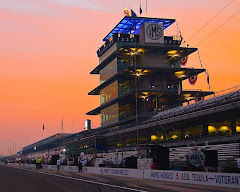
The IndyCar Series announced today that three race dates will change on the 2010 schedule.
The race at Texas Motor Speedway was moved up a week, to Saturday night, June 5. The IRL appears to have agreed to the switch in order to accommodate TMS's wish to keep the NASCAR Truck Series and IndyCar Series events on the same weekend.
The Kentucky IndyCar event was switched to Saturday night, September 4.
The Indy 300 at Twin Ring Motegi, Japan was moved to September 19 in order to take advantage of a national holiday September 20.
Wednesday, August 26, 2009


Tuesday, August 25, 2009
Indy Lights: Leilani Munter Returns

Hawaii native and former part-time Indy Lights competitor Leilani Munter will return to the IRL competition at Chicagoland. Munter will drive in the Indy Lights finale for Team 3G with funding from Women's ExtenZe (a natural female enhancement supplement, not that there's anything wrong with that), Novicomm LED Lighting Technology and Ecobabble.
Munter has worked for more than two years to leverage her environmental activism into racing sponsorship. This announcement is the first real demonstration of success.
We suggest that Leilani look to much larger enviro-organizations. These would include the U.S. Green Buildings Council. In addition, many vendors and products have attained the Energy Star designation that is becoming essential for those who serve the leviathan U.S. General Services Administration. Gathering a consortium of such vendors would seem to hold promise.
We note that these ideas are not new. The late Paul Dana, perhaps the most savvy driver in IRL history with regard to finding sponsorship, essentially created the Ethanol Promotion and Information Council, his sponsor at Hemelgarn Racing and later at Rahal Letterman Racing. EPIC dissolved following the predictable push-back against Ethanol fuel. We suspect that the ever resourceful Dana would have been in front of the story and done something about it. Bobby Rahal, whose team inherited the EPIC sponsorship after Dana's death, was not prepared. We know this because Rahal Letterman is not, in fact, an operating IndyCar team this season.
Good luck to Leilani, Jaques Lazier and Greg Beck. The latter two are among our favorite people in all of IndyCar racing. We would love to see them get a real deal in place for 2010.
Roggespierre
Munter has worked for more than two years to leverage her environmental activism into racing sponsorship. This announcement is the first real demonstration of success.
We suggest that Leilani look to much larger enviro-organizations. These would include the U.S. Green Buildings Council. In addition, many vendors and products have attained the Energy Star designation that is becoming essential for those who serve the leviathan U.S. General Services Administration. Gathering a consortium of such vendors would seem to hold promise.
We note that these ideas are not new. The late Paul Dana, perhaps the most savvy driver in IRL history with regard to finding sponsorship, essentially created the Ethanol Promotion and Information Council, his sponsor at Hemelgarn Racing and later at Rahal Letterman Racing. EPIC dissolved following the predictable push-back against Ethanol fuel. We suspect that the ever resourceful Dana would have been in front of the story and done something about it. Bobby Rahal, whose team inherited the EPIC sponsorship after Dana's death, was not prepared. We know this because Rahal Letterman is not, in fact, an operating IndyCar team this season.
Good luck to Leilani, Jaques Lazier and Greg Beck. The latter two are among our favorite people in all of IndyCar racing. We would love to see them get a real deal in place for 2010.
Roggespierre
Monday, August 24, 2009
Is this the new Indy Car? If so, then Why?

Could this be the next Indy car? Sources have informed the Committee of Public Safety that the model pictured above is getting serious consideration. The IRL is expected to announce new technical specs for the 2012 IndyCar Season.
What would this car allow the series to accomplish? How would it improve the strategic positioning of IndyCar? We must drill down to get the answers. That's why we're here.
Identifying the Job
We adopt a test first published by Harvard Business School Professor Clayton Christensen. The author of The Innovator's Dilemma and other worthy titles suggests that, when considering product development as a function of marketing, the correct question to ask is this.
- What are the jobs that the customers are trying to get done?
Three Dimensions of Marketing & Product Development
Christensen argues that each "job" people want to do has three dimensions: social, functional and emotional. IndyCar racing has traditionally focused on the functional aspect, staging motorsports events to entertain fans.
But citizens of Indianapolis know that the city has long been emotionally invested in the Indy 500 - many locals care about racing just one month per year. Apparently, citizens of Edmonton can relate, as well. Events that confirm the communities we live in are "somewhere" can take on momentum and endure hardship that other events can not. That's one reason why Baltimore is a lousy idea. If you have to street race, then we reiterate that Bridgeport, Connecticut, a stinking pile of urban blight in an otherwise privileged area, is the place to do it.
The social dimension has always been difficult for IndyCar racing. Following World War II, the Indianapolis 500 drew a multi-tiered audience that would not occupy the same place at the same time under normal circumstances. The elite could be found in the pits, garage area, hospitality tents, and suites. Families shared the main grandstands with hard-core fans. Partiers took over the infield, creating a subhuman cesspool that provided more entertainment than the race in some years.
Danton argues that the social dimension was critical to NASCAR's economic rise. Feeding on the subculture of the former Confederacy, NASCAR became a blue collar, sociologically based phenomenon that overwhelmed the motorsports marketplace in the United States. But it is not given that NASCAR's homogeneity will always provide a competitive advantage in the marketplace.
When Roggespierre attended his first Indianapolis 500 in 1978, it looked like a NASCAR race. The starting field was composed of 31 drivers born in the United States, naturalized U.S. citizen Mario Andretti and Canadian Cliff Hucul. We do not advocate a return to those days. However, a healthy base of competitive U.S. drivers would be helpful in making the Indianapolis 500 economically competitive.
Danton thinks the car in the photo looks a bit video-gamish. We're guessing that somebody told the IRL that its age demographics suck, and that young people like video games. These are facts. But the solution isn't that simple. Kids who like video games tend to get that particular job done by playing video games and not by watching IndyCar races.
Give the parents a product they want to see, don't blow junior's eardrums to smithereens, and you'll get the kids. Every other child in Middle America owned some article of Jeff Gordon merchandise in the late 1990s. His car looked like a Chevy Lumina. How many kids became fans because they liked the Lumina on the NASCAR video game? Cart, meet horse. Did Jeff Gordon make the kids NASCAR fans or did NASCAR make them Jeff Gordon fans? Now that's a question worth asking.
One way to nudge U.S. drivers toward IndyCar is to focus (not necessarily exclusively) on oval racing, a uniquely American form of the sport. Another is to reduce costs to allow the underlying economics of team participation to make sense. How much would the IRL have to slash expenses? Optimally, the cost of fielding a championship-caliber, one-car effort for the 17-race season should be approximately $1.3 million. That number is probably shocking to the present IndyCar teams, but so what? That's the value of the product they and the IRL offer in the competitive marketplace. The number would increase proportionately with television ratings and ticket sales.
So, the question becomes: would the chassis pictured above allow teams to compete for the IndyCar Championship at a cost of $1.3 million per season? If the answer is no and the projected per-season cost is nowhere near that amount, then why incur the initial capital outlay? The new car might or might not improve on-track competition, a probability that makes performance a less than compelling reason to switch cars. Conversely, the new car absolutely should increase the competition to qualify for the Indianapolis 500 - something that must happen if the Month of May in Indianapolis is to feel important enough (the emotional aspect) to attract fans on more than two days.
Another question: will this car require that teams contribute significantly its manufacture? This is absolutely necessary. IndyCar teams must recapture some of their present expenditures. Currently, virtually all racing-related expenditures flow in one direction: out of the series. Teams are happy to outsource these services so long as the IMS or somebody else subsidizes them. But that, too, must end.
So, will production of the new cars require that IndyCar teams do something more than assemble them? If the answer is no, then why do it? How does this change the consumer-competitor culture of IndyCar Racing? How does it establish new revenue streams that teams can count on when times get tough? How does it resolve the problem of monopolistic vendors? How will it enable the IndyCar Series to remain competitive when Apex Brasil determines that its stretegic objectives have been achieved? How does it differentiate IndyCar from NASCAR, where all cars look the same?
Citizens can probably tell that we are not optimistic about the new IndyCar spec. We would like to see the league 1) mandate a tub or driver compartment for driver safety, 2) publish a schedule of design constraints, and 3) let the teams and their smart engineers figure out the rest. We would like to see aero tunnels banned. We would like to see sphincter-wrenching qualifying runs at Indy again. We would like to see cars that are a little bit scary, the way race cars should be!
IRL Management: what are the jobs that your customers (ticket buyers and tv viewers, race promoters, league sponsors, broadcast partners) are trying to get done? Figure it out and help them do it!
Roggespierre
IndyCar Maxim #4

Roggespierre's Maxim #4
Courtesy of Clayton Christensen, Harvard Business School
"...the job, not the customer, is the fundamental unit of analysis for a marketer who hopes to develop products that customers will buy."
We invite IndyCar management to re-read Professor Christensen's quote, taking time to note the implicit assumption that product development is the job of marketers. This is important.
If marketers are responsible for product development, then it follows that those who work either in racing operations or for suppliers of racing teams are not. These individuals should be consulted, but they should not have final authority.
Who Cares about Torque Curves? More Cup Holders!!
Auto sales in the United States provide a good example. Engineers and designers dream-up all sorts of neat technology-based ideas for cars. They are therefore loathe to admit that one of the most important design innovations so far as U.S. auto sales are concerned is.... more cup holders! This is why engineers should not have final authority in product development.
Product development of the modern Indianapolis 500 Mile Race was more or less accidental, and yet it worked out well. Such cases are increasingly rare as marketing evolves into an analytically sophisticated, data-driven exercise.
We invite IRL Management to consider, as Professor Christensen might say, the jobs that customers are trying to get done via IndyCar racing. Do they want to witness gut-wrenching danger? Have a good time with friends? Confirm that their city of residence is somewhere important? Establish lifelong memories of experiences shared with their children? Hang out with hot babes? Get drunk and engage in debauchery? Take in colorful pageantry? Feel as if they're hip? Get away from people who are not like them?
Like any product, IndyCar Racing can't assist in each of the "jobs" above. Serving one market, as we like to say, necessarily means not serving another. But we do know that establishing a product culture of some kind will be of far more benefit to IndyCar racing than marginal aerodynamic changes, push-to-pass, or even new race cars. The latter, in fact, should be consistent with the product culture.
That way, you need not claim in successive seasons to be the "green" racing series, the "value opportunity" of the sport, and the "international" series, when in fact you are none of the three.
Roggespierre
Sunday, August 23, 2009
Franchitti wins at Sonoma; Briscoe Leads Points
Even a first-lap slobber knocker involving seven cars couldn't prevent Target Ganassi Racing and Team Penske from dominating Sunday's IndyCar race at Sonoma. Ganassi's Dario Franchitti won the event, and Penske's Ryan Briscoe claimed second and the series points lead.
Rookie Mike Conway finished third, the best result of the season for Dreyer & Reinbold Racing. Defending IndyCar Champion Scott Dixon crossed the line in tenth place, falling to third in points behind Briscoe and Franchitti, his teammate at Target Chip Ganassi Racing.
Team Penske's Will Power and Rookie Nelson Philippe of Conquest Racing were not replaced after both suffered significant injuries in a practice crash Saturday. Neither driver is expected to return this season.
Rookie Mike Conway finished third, the best result of the season for Dreyer & Reinbold Racing. Defending IndyCar Champion Scott Dixon crossed the line in tenth place, falling to third in points behind Briscoe and Franchitti, his teammate at Target Chip Ganassi Racing.
Team Penske's Will Power and Rookie Nelson Philippe of Conquest Racing were not replaced after both suffered significant injuries in a practice crash Saturday. Neither driver is expected to return this season.
Subscribe to:
Posts (Atom)